
How to add a user to the Hyper-V administrators group
Granting full local administrator rights just so a user can manage virtual machines poses a security risk. By adding an account to the built-in Hyper-V Administrators local group, the user can create, start, and configure virtual machines without having full control over the host operating system. This step-by-step guide will show you how to add local or domain users to this group using Computer Management, PowerShell, or Command Prompt.
Adding a user to the Hyper-V Administrators group grants non-administrators complete and unrestricted access to all Hyper-V features.
Method 1: Computer Management (GUI)
- Click on the Windows start menu button or the search icon on the taskbar.
- Type computer management.
- Right-click on Computer Management and select Run as administrator.
- When the 'User Account Control' window appears, click Yes. If prompted, enter an administrator password and click Yes.
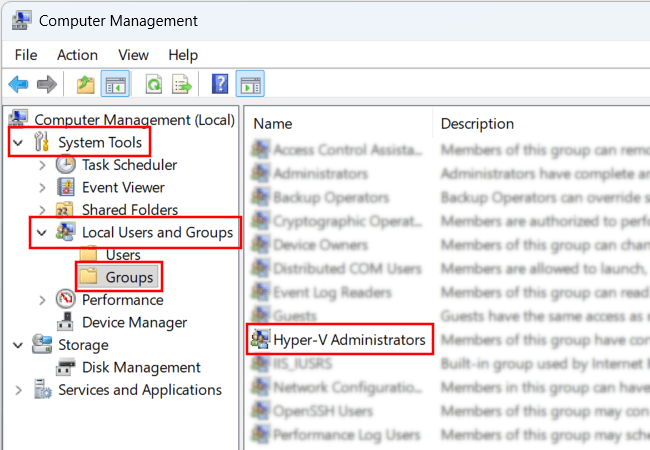
- Expand System Tools > Local Users and Groups.
- Click Groups.
- In the center pane, double-click Hyper-V Administrators.
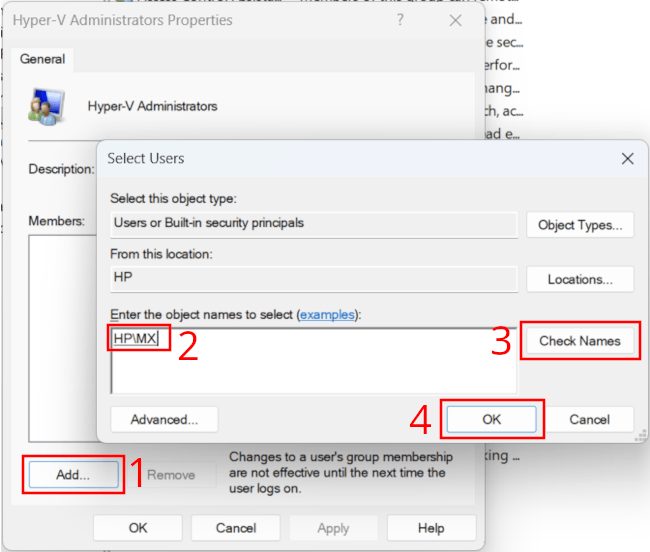
- In the 'Hyper-V Administrators Properties' window, click Add at the bottom of the window.
- In the 'Select Users' window, type the username you want to add to the Hyper-V administrators group.
- Click Check names.
- Once the correct [computer name + username] combination appears, click OK.
- Click Apply at the bottom of the 'Hyper-V Administrators Properties' window.
- Click OK.
- Restart your computer.
The user is now part of the Hyper-V Administrators group and has unrestricted access to all Hyper-V features.
Alternative method to open Computer Management as administrator: Press Windows + R > Type compmgmt.msc > Press Ctrl + Shift + Enter.
Method 2: PowerShell (CLI)
- Right-click the Windows start menu button and select Terminal (Admin) or Windows PowerShell (Admin).
- To add a local user, run:
Add-LocalGroupMember -Group "Hyper-V Administrators" -Member "[Username]" - To add a domain user, specify the domain name:
Add-LocalGroupMember -Group "Hyper-V Administrators" -Member "[DOMAIN\Username]" - Restart your computer.
Method 3: Command Prompt (CMD)
- Open Command Prompt as administrator.
- Run the following command:
net localgroup "Hyper-V Administrators" "[Username]" /add - Restart your computer.
Troubleshooting & notes
- User must sign out: The most common reason permissions fail after adding a user to the Hyper-V Administrators group is that active security tokens do not update dynamically. The target account must log off and log back in (or reboot the computer) before opening Hyper-V Manager.
- Access denied error in Hyper-V Manager: If the user gets an "You do not have the required permission to complete this task" error even when the user is a member of the Hyper-V Administrators group, verify that WinRM is properly configured and enabled or check local security policies:
Enable-PSRemoting -Force - Domain controllers note: On Active Directory Domain Controllers, local groups do not exist. You must manage group members through Active Directory Users and Computers in the Builtin container.